
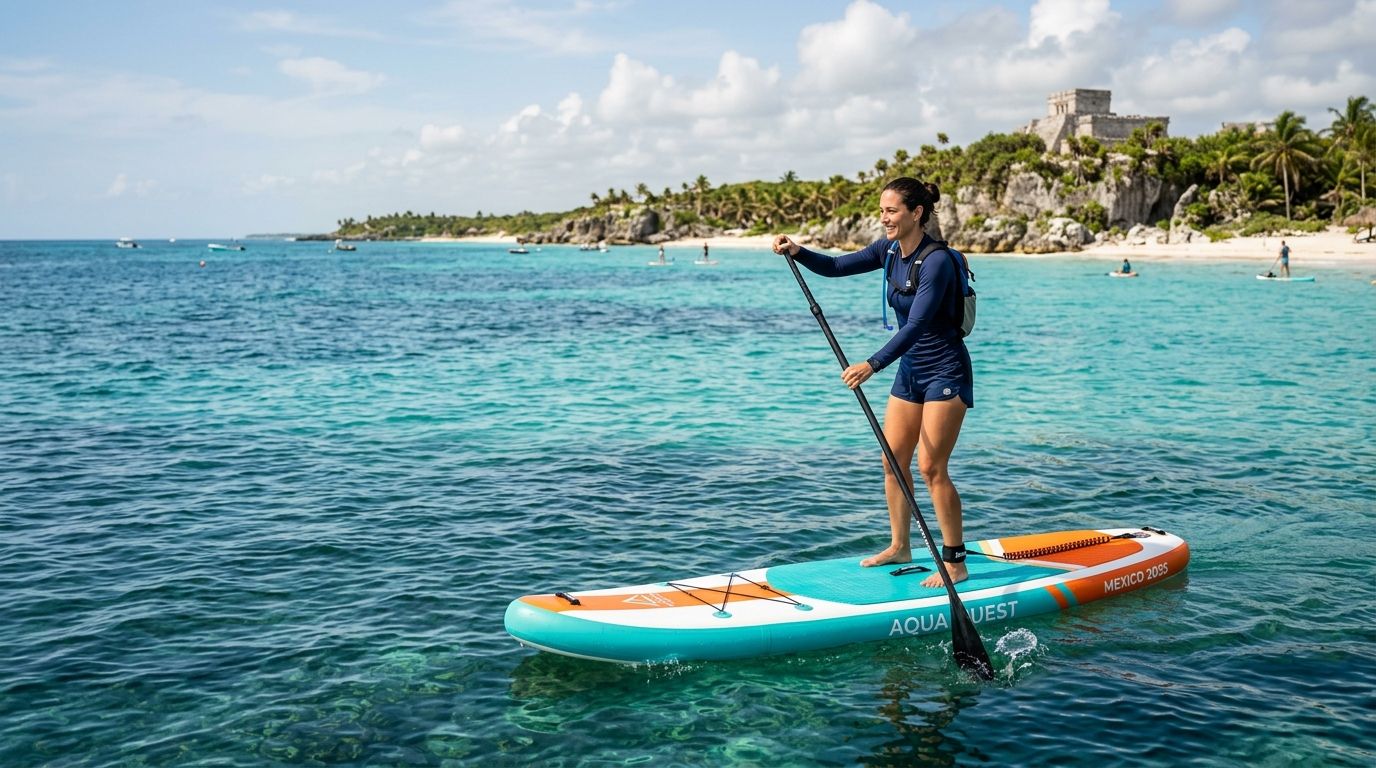
Mexico's flat-water lakes, cenotes, and calm coastal bays don't all call for the same inflatable paddle board — a beginner on Lake Chapala needs a different deck than an angler working a mangrove channel in Sinaloa. This guide ranks the seven inflatable SUP categories that matter most for Mexican conditions in 2026 and tells you which one fits your paddling plans.
- Best overall pick among the best inflatable paddle boards Mexico offers in 2026: the all-around inflatable SUP, built for stability on lakes and calm bays.
- Touring inflatable SUPs track straighter over distance, making them the pick for coastal paddles and long lake crossings.
- Fishing-specific inflatable SUPs add mounting points and extra volume for gear, ideal for anglers on Mexican rivers and bays.
- Banhi, affiliated with Aqua Marina Mexico, stocks all seven categories, so matching board to use case matters more than brand loyalty.
Why this matters
An inflatable paddle board that's wrong for the water you actually paddle gets used twice and then sits in a closet. Mexico's paddling conditions range from glassy cenotes to windy Pacific coves, and each category on this list solves a specific problem — stability, tracking, storage capacity, or portability.
Banhi's inflatable paddle board collection covers all-around, touring, fishing, yoga, kids, race, and tandem boards, which is exactly the spread this guide ranks. Picking the right category first saves you from returning a board that felt tippy on day one.
What makes the best inflatable paddle board
- Deck width and volume — wider, higher-volume boards feel stable; narrower boards move faster but demand better balance.
- Drop-stitch construction — the internal fiber weave that lets an inflatable SUP hold rigidity once pumped up.
- Recommended PSI — most inflatable SUPs firm up in the 12-15 PSI range; underinflated boards flex and slow you down.
- Included accessories — pump, paddle, leash, and repair kit determine whether you're paddling same-day or waiting on separate purchases.
- Portability — deflated size and pack weight matter if you're driving to Valle de Bravo or flying with a board bag.
- Weight capacity — matters for tandem paddling, dogs on board, or carrying a cooler.
Best inflatable paddle boards in Mexico at a glance
| Category | Best for | Standout feature | Key limitation |
|---|---|---|---|
| All-around inflatable SUP | First-time paddlers | Wide, forgiving deck | Slower over long distances |
| Touring inflatable SUP | Long-distance and coastal paddling | Tapered nose for tracking | Less stable for beginners |
| Fishing inflatable SUP | Anglers on rivers and bays | Mounting points, extra deck space | Bulkier to transport |
| SUP yoga inflatable board | On-water yoga and fitness | Extra-wide, flat deck | Not built for speed or waves |
| Kids/youth inflatable SUP | Family beach days | Shorter length, lighter pump weight | Lower weight capacity |
| Race and fitness inflatable SUP | Cardio training, speed work | Narrow hull, displacement nose | Unstable for casual riders |
| Tandem inflatable SUP | Groups and instructors | High weight capacity, dual handles | Harder to solo-carry when inflated |
1. All-around inflatable SUP: best inflatable paddle board for beginners
This is the category most first-time buyers in Mexico land on, and for good reason — a wide deck around 30-34 inches forgives shaky balance while you learn to read wind and current.
All-around inflatable SUP pros:
- Stable enough for standing, kneeling, or sitting
- Handles flat lakes, cenotes, and calm bays equally well
- Usually the most accessible entry point in a brand's lineup
All-around inflatable SUP cons:
- Wider hull means slower cruising speed than a touring board
- Less efficient for multi-hour distance paddles
Best for: first-time buyers and casual weekend paddlers. Verdict: Buy.
2. Touring inflatable SUP: best for long-distance and coastal paddling
A tapered nose and longer waterline — typically 11 to 12.6 feet — let a touring inflatable SUP hold a straight line across open water, which matters on windy Pacific coastlines or long lake crossings like Bacalar.
Touring inflatable SUP pros:
- Tracks straighter, so less energy wasted correcting course
- Faster cruising speed over distance
- Higher volume supports gear for day trips
Touring inflatable SUP cons:
- Narrower deck is less forgiving for beginners
- Overkill for short, calm-water sessions
Best for: paddlers doing 5+ km sessions or coastal exploring. Verdict: Buy if distance is the goal.
3. Fishing inflatable SUP: best for anglers on rivers and bays
Extra deck real estate, mounting points for rod holders, and a higher weight capacity make this category distinct from a standard all-around board — you're carrying a cooler, tackle, and sometimes a second person.
Fishing inflatable SUP pros:
- Mounting points for gear and accessories
- Higher weight capacity for coolers and tackle boxes
- Stable enough to stand and cast
Fishing inflatable SUP cons:
- Heavier deflated pack than a basic all-around board
- Extra features add setup time
Best for: anglers working calm rivers, lagoons, and bays. Verdict: Buy if you fish regularly.
4. SUP yoga inflatable board: best for on-water yoga and fitness
The widest, flattest deck in the category exists for one reason — a stable base for poses. Some models include a full-deck traction pad instead of a partial one.
SUP yoga inflatable board pros:
- Maximum deck stability for balance work
- Full traction pad reduces slipping
- Doubles as a general all-around board for calm water
SUP yoga inflatable board cons:
- Wide, flat shape is slow and hard to paddle in wind
- Not designed for chop or current
Best for: yoga instructors and fitness paddlers on flat water. Verdict: Buy for studio-style sessions, Skip for open water.
5. Kids and youth inflatable SUP: best for family beach days
Shorter length — often 8 to 9 feet — and a lighter deflated pack weight make this the category parents reach for when introducing kids to paddling.
Kids/youth inflatable SUP pros:
- Lightweight enough for a child to help carry
- Shorter length is easier to maneuver at low speed
- Sized as a secondary board rather than a household's only SUP
Kids/youth inflatable SUP cons:
- Lower weight capacity limits use to smaller riders
- Not suitable as a primary adult board
Best for: families paddling together at the beach or lake. Verdict: Buy as a second board, not a first.
6. Race and fitness inflatable SUP: best for cardio training and speed
A narrow, displacement-style hull trades stability for glide — this is the category serious paddlers use for interval training and distance-time goals.
Race/fitness inflatable SUP pros:
- Fastest cruising speed in the inflatable category
- Efficient for structured cardio sessions
- Rewards good paddling technique with real speed gains
Race/fitness inflatable SUP cons:
- Unstable for anyone without solid balance already
- Poor choice for casual or leisure paddling
Best for: paddlers training for fitness or racing. Verdict: Buy only if you already paddle regularly.
7. Tandem inflatable SUP: best for groups and instructors
Built with dual paddle handles and a high weight capacity, a tandem inflatable SUP lets two adults — or one adult and a dog — share a single board without sinking the rail.
Tandem inflatable SUP pros:
- Highest weight capacity of any category here
- Two people can split the paddling load
- Useful for instructors demonstrating technique
Tandem inflatable SUP cons:
- Heaviest board to carry once inflated
- Overkill if you paddle solo most of the time
Best for: groups, couples, and paddle instructors. Verdict: Buy if you regularly paddle with a partner.
How we ranked these categories
Each category above was scored against the same six criteria — deck width and volume, drop-stitch build quality, recommended PSI range, included accessories, portability, and weight capacity — then matched to the Mexican paddling conditions where it performs best. No two categories share the same best-for slot, so the list functions as a decision tree rather than a leaderboard.
Find your inflatable paddle board
Browse Banhi's full inflatable SUP range by category.
Which inflatable paddle board should you choose?
If you're paddling for the first time on a Mexican lake or calm bay in 2026, the all-around inflatable SUP is the default pick — it's stable, versatile, and forgiving while you build skill. Anglers should go straight to the fishing category, distance paddlers to touring, and anyone doing structured cardio to the race and fitness board. Buying the wrong category costs more than buying the wrong brand.
FAQ
What is the best inflatable paddle board for beginners in Mexico?
An all-around inflatable SUP is the best inflatable paddle board for beginners in Mexico because its wide deck, roughly 30-34 inches, stays stable on lakes, cenotes, and calm bays. It is the most forgiving category while you learn balance and paddle technique.
Is a touring inflatable SUP better than an all-around board?
A touring inflatable SUP is better for distance and coastal paddling because its tapered nose tracks straighter, but an all-around board is more stable and better for beginners. Choose touring only once you have paddled enough to trust your balance.
How much PSI should an inflatable paddle board be pumped to?
Most inflatable paddle boards perform best inflated to 12-15 PSI. Underinflating leaves the board flexing under your feet, which slows you down and increases fatigue.
Can kids use a regular inflatable paddle board?
Kids can use a standard all-around board with supervision, but a dedicated kids or youth inflatable SUP is lighter to carry and shorter to maneuver. It is the better first board for a child paddling solo.
What is the difference between a fishing inflatable SUP and an all-around board?
A fishing inflatable SUP adds mounting points for rod holders, extra deck space, and higher weight capacity for gear. An all-around board lacks these features but works fine for casual fishing trips without extra equipment.
Is a tandem inflatable SUP worth it for two paddlers?
A tandem inflatable SUP is worth it if you regularly paddle with a partner or a dog, since it carries more weight than a solo board without sinking the rail. It is not worth it if you paddle alone most of the time.
Do race inflatable SUPs work for casual paddling?
Race and fitness inflatable SUPs are unstable for casual paddling because their narrow hull trades stability for speed. Stick to an all-around board unless you already paddle with confident balance.
What accessories come with an inflatable paddle board?
Most inflatable paddle boards ship with a pump, paddle, leash, and repair kit, though exact inclusions vary by model. Check the specific product listing before assuming a paddle or leash is included.
One last thing
The category you skip is usually the one you end up wanting six months later — paddlers who start on an all-around board often add a touring board once they have logged enough hours to want more speed. Buy for where you are paddling this season in 2026, not where you hope to be paddling next year.